
Speech
DPM Gan Kim Yong's Opening Remarks at the Institute of Policy Studies’ Singapore Perspectives 2026
People
DPM Gan Kim Yong
Topics
Economy
Education
Families and communities
Population
Social safety nets
26 January 2026
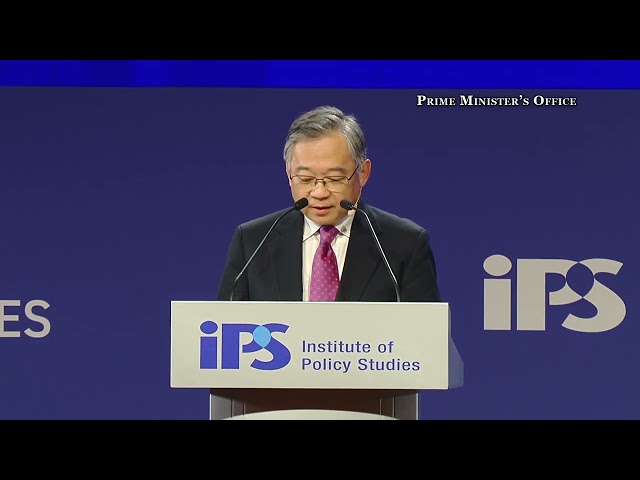
Transcript of Deputy Prime Minister and Minister for Trade and Industry Gan Kim Yong's opening remarks at the Institute of Policy Studies’ Singapore Perspectives 2026 conference on 26 January 2026.
Ladies and Gentlemen,
Thank you for inviting me to speak to you.
We are living through a period of significant transition. Digital technologies are reshaping how economies function, how work is organised, and how people interact with one another. Artificial intelligence is beginning to influence productivity, decision-making, and everyday routines. Social media and digital platforms have transformed how information flows and how relationships are maintained.
At the same time, many societies are grappling with the issue of trust, cohesion and sense of belonging. These concerns are really not new, but they take on renewed significance in a world where interactions are increasingly mediated by technology, and where economic and social change is occurring at speed.
For Singapore, this is a particularly relevant conversation. We are a small, diverse, and humble society. Our cohesion does not rest on a single identity or shared background. It rests on how people of different backgrounds live, work, and interact with one another over time.
In this context, it is useful that this year’s Singapore Perspectives reflects on fraternity – or in other words, the relationships, shared norms, and habits of cooperation that allow people to trust one another and to function collectively, even amidst diversity.
We also often refer to it as social capital – the networks and informal expectations that support cooperation, reciprocity and collective action.
Fraternity is not about sameness or uniformity. Nor is it about constant agreement. It is about whether people who differ in background, outlook or circumstance nonetheless see one another as part of a shared social community.
For a society like Singapore, this has always mattered. Diversity is a fact of life. Fraternity is what allows diversity to be a source of strength rather than a cause of fragmentation.
Why fraternity takes on added importance in a digital age
It is sometimes assumed that as societies become more digitally connected, the role of social ties rooted in place or institutions diminishes. The evidence suggests a more nuanced picture.
Digital tools make communication easier and more convenient. At the same time, they shape who we interact with – often through personalised feeds, self-selected networks, and interest-based communities.
People may be highly connected, but within relatively narrow social circles. Access to information expands, but trust does not automatically deepen. Communication becomes more efficient, but to build shared understanding still requires time and interaction.
Seen in this light, digitalisation does not remove the relevance of fraternity. Instead, it places greater weight on the underlying social fabric that supports trust, cooperation, and a sense of shared purpose.
What the evidence tells us about social ties in Singapore
Recent survey research by IPS on friendships and social networks in Singapore provide several useful observations.
First, close and meaningful relationships continue to form largely through in-person settings, such as schools, workplaces, neighbourhoods, and community settings. Digital platforms play an important role in maintaining contact, but they tend to complement rather than replace face-to-face interaction.
Second, the diversity of social ties matters. Individuals with greater diversity of friends across age, income, education, housing type, or ethnicity are more likely to report a stronger sense of belonging; Higher levels of trust in fellow Singaporeans; Greater confidence that people share common values; and higher participation in civic and community activities.
Conversely, where social networks are narrower and more homogeneous, these outcomes tend to be weaker.
This points to an important aspect of fraternity: it is not simply about having close relationships, but about who those relationships are with. Fraternity grows when people have meaningful ties that cut across social and economic divides. This would engender a virtuous circle of social trust that leads to deeper social relations.
Third, social networks continue to reflect broader social and economic structures. Without opportunities for interaction across groups, networks can remain segmented, even in a digitally connected society.
These findings suggest that fraternity is shaped not just by whether people are connected, but by how broadly and across whom those connections are formed.
Why fraternity matters for Singapore
These findings point to fraternity playing a quiet but consequential role in three areas: economic competitiveness, social resilience, and national identity.
Economic competitiveness
First, on economic competitiveness. Singapore’s economic model has always depended on openness: to trade, to capital, to ideas, and to people.
We compete not by size or scale, but by being a place where global firms and talent are willing to operate over the long term. This rests on more than regulatory clarity or economic incentives; it is also shaped by how society functions day-by-day.
The survey findings are instructive here. They show that individuals with more diverse social networks tend to report higher trust and a stronger sense of belonging. These traits shape whether a society is experienced as welcoming, adaptable, and easy to integrate into.
For global talent, the decision to come and to stay is rarely based on work alone. It is also about whether one can build relationships, feel accepted beyond the workplace, and sink roots here.
Therefore, stronger and more diverse social bonds make integration easier:
Conversely, when social networks are narrow and segmented, differences are sharper and openness becomes harder to sustain in practice, even if policies remain open in principle.
In this sense, fraternity supports economic competitiveness by lowering social friction and expanding our absorptive capacity, which, as a small and open economy, is one of the key elements of our economic competitiveness.
Social resilience
The next implication relates to social resilience. The survey shows that people with more diverse friendships are less likely to feel socially distant, more likely to trust others, and more likely to participate in civic life. These characteristics matter most during periods of stress and transition.
Economic restructuring, technological disruption, demographic ageing, and global uncertainty and even pandemics like COVID-19, all place pressure on societies. Stronger social bonds strengthen the ability of a society to withstand these disruptions and bounce back in several ways. First, diverse networks reduce isolation. Individuals connected across different segments of society are less likely to feel excluded or left behind as circumstances change. Second, fraternity supports cooperation. Where trust is higher, people are more willing to accept trade-offs, support transitional measures, and participate in collective responses for the greater good, whether during economic downturns or public stress. Third, broader social networks act as informal support systems. Individuals with more diverse ties are more likely to have access to emotional, informational, or practical support when they need it.
From this perspective, fraternity therefore becomes a source of social resilience. It does not eliminate disruption, but it affects how disruption is experienced and managed.
National identity
The third implication is more fundamental. For a small, multicultural nation, identity is not inherited automatically. It is built and renewed through everyday experience.
The survey findings suggest that when people have friendships that cross social boundaries, they are more likely to feel emotionally attached to Singapore and more likely to believe that society shares common values.
This points to an important insight: national identity is not shaped only by shared narratives or symbols, but by personal relationships that make difference familiar rather than threatening.
Fraternity, in this sense, is how a diverse society becomes a shared community. It allows people to encounter difference through trust rather than abstraction, and to maintain a sense of “us” even as society evolves.
In a global environment where polarisation and identity-based divisions are becoming more pronounced, this is not incidental. It is central to how a small, diverse nation stays united and cohesive.
Looking ahead
Over the decades, we have always balanced openness with cohesion, and diversity with shared purpose. Singapore’s success has never rested on size or resources; it has rested on trust – between citizens, between workers and employers, between communities, and between the people and the Government.
As Singapore navigates its next phase of development amidst technological change, demographic shifts, and a more uncertain global environment, we must strengthen our social bonds – at work, in schools, in our neighbourhoods, and in the many spaces where people encounter one another in ordinary ways. Even in a digital age, what matters is not just how we are connected, but how connected we are to one another.
By strengthening the everyday bonds between us, we give Singapore the confidence to remain open, resilient, and united in a changing world. This is how we should move forward.
Thank you.