
Dialogue
PM Lawrence Wong at the 24th Forbes Global CEO Conference Grand Finale Dinner (Oct 2026)
8 October 2026
People
PM Lawrence Wong
Topics
Economy
Transcript of PM Lawrence Wong at the “A Meeting of Minds” Conversation at the 24th Forbes Global CEO Conference Grand Finale Dinner on 8 October 2026.
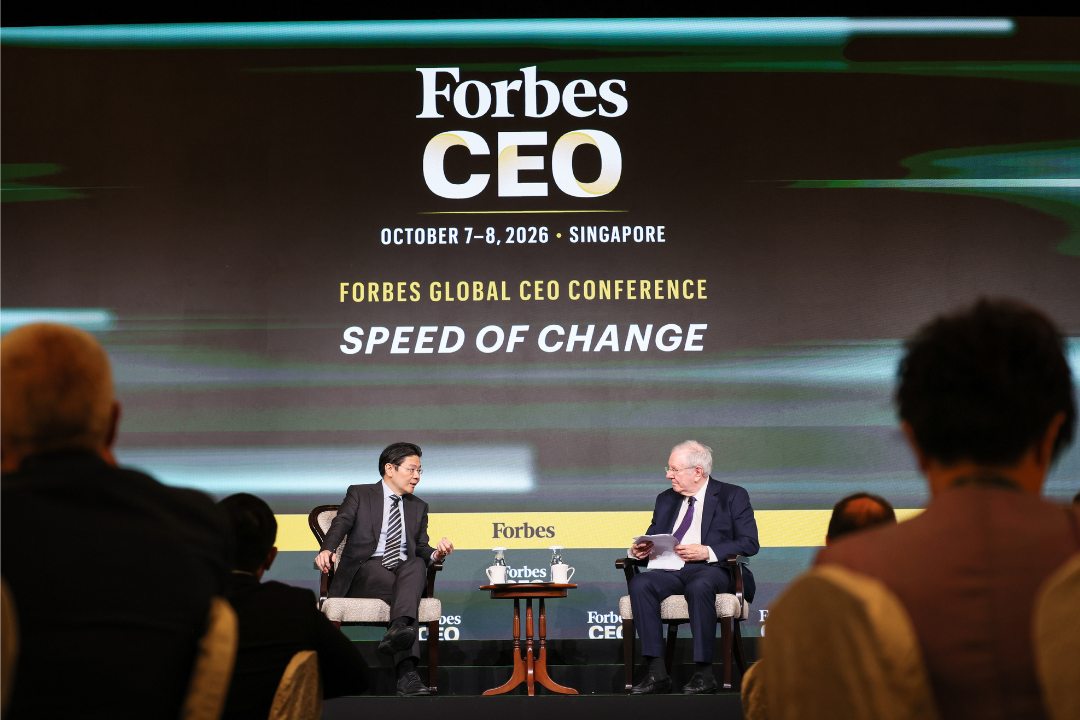
Moderator (Steve Forbes, Chairman and Editor-in-Chief of Forbes): Thank you, Prime Minister, Finance Minister, all kinds of ministers.
Prime Minister Lawrence Wong: Just two.
Moderator: To be with us tonight. I have to make an announcement, disappointment: there is no concert tonight.
PM: Not at all. I did not bring my guitar.
Moderator: Well, why don’t you just disabuse the rumours that have been going around that with your fellow Prime Ministers in ASEAN, you are going to form a band?
PM: That is President Marcos’ wish, but I am not sure if it will come true. We will see.
Moderator: Does that mean your agents are going to negotiate a good deal?
PM: We will keep talking.
Moderator: Well, it is a great pleasure to have you here. As you know, 25 years ago we had the first CEO summit conference here, thanks to Singapore and EDB, and came at a very tough time right after 9/11, and people wondered whether it would come to pass. But thanks to the cooperation of the team here, it did come to pass. We were able to fly over just on the day that they removed the banning of flights after 9/11, and we thought it would be a one-time conference. But here we are, 25 years later, and still trying to add a musical element. But at least we have you here tonight.
And one of the things – before we get into some of the subjects, little ones like energy – explain the unusual way, and you keep updating it, Singapore does, on attracting high-quality people to the government by paying very high salaries.
PM: Wow, you cut right to the chase, Steve! No time for warm-up.
Moderator: Well, I offered you the opportunity to play the guitar.
PM: Well, our starting point is: Is government important? Is good government important? And I believe most of us will say “Yes. Good government is important.” Then, if good government is important, what do you need to do to get good government? And surely, if good government is important, you would want the best, a few of the best in every cohort to be able to serve in government. How do you get them to come? I think you have to identify people with the right character and values, and appeal to their sense of purpose and their sense of meaning and calling.
So that is what we try very hard to do. But having done so, there is a practical issue because we are talking about people who are successful in their own careers. They could be doctors, lawyers, business people, earning easily more than a million dollars a year, and on that basis of their salaries, they would have made their own financial commitments for themselves, their spouses, and their children.
So what we try to do in Singapore is to have a salary framework for ministers, which is competitive. It will not match their private sector pay, but it is broadly competitive. There will still be a discount, but at least the burden and the financial loss and the hurdle of entering politics is not so great. And on that basis, we have been able to attract and retain good people in government these last 60 years.
We are now in the fourth generation of leadership renewal. I am the fourth Prime Minister. My mission is not only to complete my term as Prime Minister, but to make sure that I can attract and bring in another generation of leaders whom I can pass the baton to in due course. And that is how we keep Singapore going.
Moderator: We were discussing at dinner what you have done, and your predecessors have done. Singapore is uniquely successful in a very often very turbulent world, year after year, and I was wondering if you would just quickly explain why others do not imitate what you do. Now, you obviously are a small, relatively small entity, but principles of success are constant, whether small or large. And you are a living success story. Why don’t others say, "Aha, this is the way to go. It works”?
PM: We are happy to share our experiences. There is no secret.
Moderator: Free of charge, right?
PM: There is no secret formula. We share; it is an open book. We invite officials to come. We provide training programmes. It is for others to decide whether they want to do like we have. And we often tell them it is not just a cut-and-paste exercise, because policies and programmes have to adapt to local context and circumstances. And every country is different, every society is different. But we are always happy to share.
Moderator: Well, we have the [US] Ambassador here, so I have to be careful what I say. But perhaps you can visit my country.
PM: I should not say anything.
Moderator: That means you will be able to come to my country. But one of the challenges now, and there is no easy answer, is one of the things about – especially in public life and commerce as well – unexpected crises. Who, a year ago, would have thought we would have an energy crisis, a crisis with the Straits of Hormuz? How are you coping with it, and how are you working with your neighbours through ASEAN to try to cope with something that is extremely difficult, especially when it is so unexpected?
PM: It is. When it started out, when the conflict first broke out, we were all prepared for a worst-case scenario where we thought there might be a severe curtailment of energy supplies, and we could even end up in a COVID-like situation where countries scramble for oil, energy, and essential supplies.
I think, fortunately, that worst-case scenario has not panned out, has not materialised. It reflects the adaptive and resilient nature of the global economy. Countries and companies have been able to adapt and adjust, and we see that in Singapore. We are an energy hub. We have refineries here. Our refineries were able to source for crude oil from outside the Middle East. It is a different grade of crude, so they had to re-tune their operations. It resulted in lower output, but they were still able to operate and service all their customers in Singapore and beyond.
So these are the kinds of adjustments we have seen. I think the situation now is one where we are prepared not so much for a sudden and severe dislocation. I think that risk has come down, but we are prepared for a prolonged conflict situation where energy prices will remain high for longer, where there will be higher inflationary pressures; not just due to energy, but the feedthrough into food and other materials and supplies, and also because there are now greater costs in supply chains, due to tariffs and whatnot. And all of that may eventually impact on global growth. I think that is something we are prepared for.
But in Singapore, our fiscal position is strong and healthy. We are able to take decisive actions if needed. And so, even in the last few months, we have already rolled out two support packages to cushion the impact for households and businesses. And if things get worse, we will be prepared to do more.
Moderator: Amazing. And one of the things you have, rightfully I think, spoken out on – freedom of navigation. In my country, the belief in freedom of navigation goes back to Thomas Jefferson fighting the Barbary Wars. And what is your outlook now? There is still occasional talk about tolls and restrictions. Even the Strait of Malacca doing the same thing. What is your outlook on freedom of navigation?
PM: We are concerned. We are concerned that what is happening in Hormuz may set a precedent for elsewhere, because if a critical international waterway can be weaponised or arbitrary tools imposed on shipping through something like Hormuz, then countries may be tempted to do the same elsewhere.
And in our part of the world, the critical maritime chokepoint is the Straits of Malacca and Singapore. The littoral states, the three littoral states surrounding the Straits, are in Malaysia, Indonesia, and Singapore. And so I have discussed this with my counterparts – Prime Minister Anwar in Malaysia, with President Prabowo in Indonesia – and all of us are fully aligned on the fundamental principle, which is that international waterways must remain open, freedom of navigation and the right of transit passage has to be respected, and international law upheld.
So we are fully aligned on that. Even if you may hear rhetoric to the contrary, the leaders are aligned. We will defend these principles strongly, and we will work with partners to uphold these principles.
Moderator: That is essential because when you start putting barriers on waterways, it is like tolls on highways. It interferes with commerce.
PM: For sure, for sure.
Moderator: And one of the things – a subject that may be sore with some; I have made my views clear on it – is tariffs. That is another word – for those who do not know – for tax. And as Warren Buffett said, the tariff is not paid by the tooth fairy. Real people have to pay it. And what is amazing in the case of your country, one is: you have no tariffs on American imports.
PM: No, we do not. We have a Free Trade Agreement with America.
Moderator: And America has a trade surplus.
PM: On goods with us.
Moderator: And yet, you got hit with 10%. Now it is, under another law, 12.5%.
PM: Yes.
Moderator: Well, we have a fellow here tonight.
PM: The right tariff should be zero.
Moderator: I like that sentiment. And the tariffs are a barrier, and one of the things that Singapore has thrived on and showed how the world you can thrive on it, is by reducing barriers, is by free trade. Looking around the world, are we going to be going into a period where we have these trading blocks and deals that have commerce that is not natural and end up costing or not getting as much as we should? How do you see this world out there? How are you and your team prepared to adjust to a circumstance that goes against prosperity?
PM: Unfortunately, I think the world is heading in that direction. It is not just the tariffs that America has imposed, but other countries are also starting to put up more barriers to trade because increasingly there is concern about competition. There is concern that exports from other countries will impact on local industries, will impact on jobs. So you can see the pendulum shifting. Industrial policy is back in fashion. Countries everywhere are looking to put up more barriers to protect their own industries. So we fear that is the way the mood is; countries are moving in that direction. I do not think it means trade will no longer exist, because trade still must flow, and trade is growing. We see more trade, but the global economy will become more fragmented and fragmented by regions. In such an environment, what can Singapore do?
Well, we are still a trading nation. Trade remains three times our GDP (Gross Domestic Product). We cannot afford to turn inwards. We will get poor very quickly if we do so. So our strategy is to deepen and diversify our connections. We will do so with Southeast Asia and accelerate the integration in ASEAN, and we will have some initiatives to do more on that front when we become Chair of ASEAN next year. We will step up our connections with existing partners, and I think there are also opportunities with new regions like Latin America, Africa and the Middle East, which we hope to do more. So that is our strategy. I think in a fragmented world and a fragmented global economy, region by region, these different regions still need to connect with one another, and we hope to be one of these connectors.
Moderator: You have proven your capacity to be a very prosperous connector. Do you think, do you have hopes that in the next few years the pendulum will swing again? That we should have learned from the 1930s that when there is more and more openness, we get more and more prosperity. Do you see it, or do we have to go through this more before people see the light again?
PM: I am afraid we have to learn the painful lessons before you see some enlightenment along the way. This is true throughout human history.
Moderator: Well, yes, we will try to change the course of human history.
PM: But in Singapore, we are very clear. We have to remain open. We have to keep trade flowing. We have to remain a place that is stable and trusted, a place where businesses can innovate, invest and plan for the long term with confidence. And we are determined to remain such a place in Singapore. I think in a more unpredictable and messier world, stability and trust matter more than ever.
Moderator: So you, not to offend anyone religiously, but you will be like a monastery in the Dark Ages. I can say that.
PM: We are, we hope to be a light on the hill, shining brightly in a dark world.
Moderator: Or lighthouse in the fog. But I will say it in terms of tariffs, there is chatter about transmission. Can you comment that if the company of one country sets up a facility in another country, it is not a dodge; it is doing business. Walk us through that.
PM: Sure. No, we know that there are concerns in the US administration about circumvention of tariffs. We understand that, and we have tried to explain also that yes, you may be very concerned about attempts to circumvent, but there are also legitimate business reasons why a company would set up operations in a country and then export from that country. And there are very clear rules of origin that determine substance. So if you have an investment in Singapore, an investment in Vietnam, an investment in Mexico, and the substance is there, then it is a Mexican export; it is a Vietnamese export; it is a Singapore export. It is not a Chinese export. That is what Rules of Origin make very clear. We will have to keep explaining it and hoping people understand these rules.
Moderator: We will try to help on that. Coming up, one of the things that outsiders may not recognise about Singapore is how strong you are in high tech. You have 10% of the world's semiconductors are made here. About one-fifth of the equipment used to make them are done here. Walk us through an aspect of Singapore that a lot of outsiders do not recognise.
PM: It is a big part of our economy, the semiconductor industry. We do not make the most advanced AI chips, but we have major firms here like GlobalFoundries, Micron, and they make memory chips and specialty chips, which are in demand now with the AI boom. And on top of that, we have built an ecosystem for semiconductors. So the precision engineering industry is here. The equipment suppliers are here. And that is why the whole industry is thriving now with demand for AI, and our economy has been growing at five percent for the last three years, including this year, which is remarkable, given where we are in terms of per capita GDP to be able to grow at five percent consecutively for three years with productivity at more than three percent – it is considerable.
So it is not just that the AI boom has benefited the semiconductor industry and the related industries. We have also seen positive spillovers into other industries like logistics and professional services.
Moderator: What are your thoughts on how long can this boom last? You talk about five percent growth. I have seen possibilities you may peak at six percent.
PM: No boom is forever. At some point there will be a correction, and we do not know when it will happen or how it will happen; we do not know who the casualties will be when it happens. But no boom is indefinite. So our approach is to make good use of this window of opportunity now, where there is external demand, capitalise on it, build new capabilities, and create better jobs for Singaporeans.
Moderator: How do you see Singapore walking through the transition to AI? There may be a bubble burst, but the technology is real.
PM: It is real.
Moderator: And a couple of things on that. How are you dealing with even though net jobs will be created, there will be displacement. How do you deal with that? And also then another part is how you think we might regulate or do rules on AI so that we do not end up destroying it because it looks like it gets out of hand, in terms of the abuses of it?
PM: On the jobs front, these are still early days. We do not quite know yet what impact AI will have on the jobs market, but clearly some jobs will disappear, and many jobs will have to change. So our approach is not to protect the job, but to protect every worker. And we can do this in Singapore because we are small, compact, and because of how we are organised and structured. In some countries, businesses and governments will regard unions as obstacles. We do not do that in Singapore; we take a different approach. We do not just tolerate unions; we embrace unions as partners. And our unions also have an enlightened approach.
Moderator: Can they educate our unions? Enlightened approach?
PM: Our unions know that it is better to enlarge the pie, rather than to fight for a bigger share of a smaller pie. So that has brought about a strong compact in Singapore over the decades between the government, employers, and unions, and we work together for win-win outcomes for everyone. So on that basis, we can roll out AI and make sure that the benefits of AI are shared widely.
To give a very concrete example, we provide government grants to enterprises. The unions are the ones that help to administer these grants. So the unions have empowerment. They go to management – we offer you grants for enterprise transformation, for IT, but you take care of workers, and you help workers reskill and upskill. To be clear, it does not mean that the company cannot lay off workers because with automation, some jobs may be lost. But what we ask is that companies are fair; go for retrenchments only as a last resort. And if you have to retrench, treat the workers fairly, pay them retrenchment benefits, give them advance notice, and inform the unions so that the unions can work alongside the workers, help them to retrain and eventually get a job. And so that is what we have been doing. And I think we can, through that kind of a tripartite approach, ensure that AI benefits all workers.
Moderator: You just mentioned about it is early days with AI. You have expressed some general thoughts on perhaps having some regulation from the UN or something. Lay out your preliminary ideas on how we make sure people trust it rather than fear it.
PM: So that is your second question earlier too on the risk of AI and AI safety. I see AI safety at two levels. First, it is the risk of more powerful and autonomous AI systems, and the risk there is a potential loss of control of these systems, and the risk of rogue agents or rogue actors using these capabilities to do terrible damage at a large scale, and we are talking bio-terrorism, cyber-attacks, maybe even creating weapons of mass destruction.
No country can deal with this risk alone, and that kind of a risk is specifically more with the frontier lap. So it is very good that America has announced an initiative around this and appointed a task force to oversee this space. But eventually we think the rules and standards for frontier AI development has to be international. It cannot be just confined to a single country. So ideally, international safeguards are put in place, perhaps under the auspices of the United Nations, but that will take time. So that is one aspect of AI safety.
A second aspect of AI safety would be the safeguards and rules that you put in place when AI is deployed sector by sector. So there, we are not talking about frontier AI; we are talking about AI application. And I think there the requirements will vary from sector to sector, and the decisions every sector regulator will have to make will be – what sort of decisions ought to remain within human control; where is the human in the loop? And what kind of safeguards do you have for your sector? And it will vary from healthcare to finance to advanced manufacturing.
So just today, the central bank in Singapore – the Monetary Authority of Singapore – published risk guidelines for the use of AI and finance in Singapore. And in transport, for example, we are testing autonomous cars in Singapore. Waymo is doing a pilot here, and again, we are testing the technology, understanding safety requirements. Eventually, we will roll out and expand the deployment of autonomous cars, but with some regulatory oversight. And we want to make sure that the rollout is not only safe, but we will do it progressively so that we can manage the impact of autonomous cars on existing drivers too. So that is our overall approach at the sectoral level, focusing on the application of AI, but making sure that we do so responsibly and safely, and that AI benefits a wide segment of the workforce.
Moderator: In my country, one of the things that people say that in terms of making sure companies have safeguards, is that we have a very vigorous litigation group in the US and the company knows that if something goes wrong, they will get wrung out in the courts. So you have a more scientific approach, but maybe this frontier approach works too. We will see.
But one of the fruits of the stability of Singapore over the years is you attract a lot of wealth. You attract a lot of capital. People park it here, knowing that it is not going to go “poof!” the next day because of misgovernment. Hong Kong tried to get in that sphere, and you responded very quickly that Singapore is going to remain the premier place. Walk us through that.
PM: Well, we watch Hong Kong, Hong Kong watches us. That is normal. We are competitors, but Hong Kong is not our only competitor. There is London, there is New York, there is Dubai. There are other financial centres, so we compete not just on tax, we compete on our capabilities, we compete on institutional quality, on being a safe and stable place for doing business. So it is competition in the broader sense, and we embrace the competition. I mean, I think competition only motivates us to want to do better and to make sure that Singapore always remains the best place to do business.
Moderator: Did you enact some new incentives?
PM: Yeah, you have to always make sure your incentives are competitive. That is part of staying competitive. But like I said, it is not only about tax incentives. It is a wider range of capabilities as well. And at the end of the day, as we draw in capital, I think we want to make sure that the capital is legitimate. That is very important to us. It is productively used, and it adds to our capabilities. It adds value to Singapore and to Singaporeans. It creates better jobs for our people.
Moderator: You hit on something very important. Reputation is everything. And three years ago, you uncovered a $3 billion money-laundering ring, and since then you have not hesitated to fine banks, or tighten the law, raise the bar for family offices. Walk us through a few of the things you have done to make sure that reputation does not get damaged; if something goes wrong, it is dealt with immediately and decisively.
PM: Well that is so critical for us because I think, increasingly, when investors look at where they would put their monies, they are looking at where can I put capital for the long term? Where is the place where the rules are clear and the institutions are sound, stable, and strong? And we want Singapore to be one of these places. So, integrity, trust, is uppermost on our considerations. And so, if there is wrongdoing, if there is illicit money, we will take action, and we will not hesitate to do so as we have demonstrated three years ago.
Moderator: That is critical. Cost of living is obviously an issue thanks to circumstances beyond your control. You mentioned helping out people who may have been temporarily straitened. Is there any other measures to be taken to deal with the high cost of living? Singapore is not a cheap place to live.
PM: Not at all.
Moderator: And so how do you cope with that politically?
PM: Well, we always remind people – cost and incomes are two sides of the same coin. You cannot ask for high incomes and low prices because the services that you consume, what you pay, forms a salary for the people who provide those services. So what is critical is real incomes – incomes after netting off inflation – and so we watch that very carefully and make sure that real incomes continue to rise across all segments of our population, not just at the top level, not even at the median, but especially at the lower end. And we want, of course, income inequalities to continue to come down. And so far, it has been happening. And our general approach, where it comes to cost and affordability, is to say, look, if prices are high, we recognise that these are legitimate price signals. We should not artificially have the Government intervene to cap prices because that may lead to a lot of unintended consequences.
Moderator: Yes, always.
PM: Always. One of the reasons why, during the energy crisis, we have been able to get supplies of crude oil into Singapore is that we are buying oil at market prices, whatever the market price. If we were to say no, I should not buy at $120, I will only buy at $80, who is going to sell to us? Then you will have a supply crunch. So if prices are high, we accept that these are market prices. But what we do, instead of intervening to cap the price, is to provide targeted support for the households and the groups that need that support. So we do that for utility rebates. We do that for targeted cash support for low-income and middle-income families.
Moderator: And one of the things that faces this part of the world – some other countries more than others – is the pressure from China on disputed areas in this region. Do you see hope that perhaps a negotiated agreement can be made with ASEAN to make sure lines are drawn and we can get to the business of exporting resources instead of having boats bumping into Filipino fishermen.
PM: The negotiations are ongoing. We are not one of the claimant states, but there is an ongoing negotiation for a Code of Conduct between China and ASEAN, and perhaps it can be settled within this term with Philippines as Chair. If not, then we will take over when Singapore becomes Chair, and we will continue to facilitate these negotiations. But all parties are sincere and focused on achieving an amicable solution when it comes to a Code of Conduct that will help, hopefully, minimise the risk of escalations and conflicts going forward.
Moderator: Also helps with freedom of navigation.
PM: For sure. We are not a claimant state, but our stance has always been that we want to uphold international law, UNCLOS (United Nations Convention on the Law of the Sea), and freedom of navigation.
Moderator: Nuclear power – what is the future of that in this new environment?
PM: We are taking some steps to examine the feasibility of civilian nuclear power. There is an IAEA (International Atomic Energy Agency) process for this – phase one, phase two, and so on. So we are embarking on phase one, which is a very preliminary stage where you examine whether the country has the ability to even consider civilian nuclear power. So we are undertaking that exercise, and we will see. We will go through the due process. We will publish the results of that study, and if there are concerns, then we may not be able to proceed. But if the study shows that it can be done in Singapore, especially with newer technologies and the small modular reactors that are surfacing now, then we will consider whether or not to take the next stage. So we are doing it in a very deliberate and careful manner, so that we can continue to get public trust and support behind such an initiative. We do not want to rush this. It is a very important and critical undertaking, and we have to get it right. You do not have the chance to do it the second time if you fail to get it right the first time.
Moderator: Sensitivities are very high. You export pharmaceuticals to the US.
PM: We do.
Moderator: And where does that stand in terms of the future, doing more, and also the tariff issue?
PM: Well, whether it is on semiconductors or pharmaceuticals, a lot of American companies are here exporting, doing business, manufacturing, and then exporting back to America. So for now, for the pharmaceuticals, I think the understanding is that if they have investments back in America, they will not be imposed tariffs. So that has settled the matter for pharmaceuticals.
For semiconductors, we are still waiting for the outcome of discussions on what sort of sectoral tariffs may be imposed on the semiconductor sector, and whether similar concessions that were obtained for the pharmaceutical sector would apply to the semiconductor industry. It is still ongoing. But the American MNCs that are here are considerable, and we welcome them. They play an important part in our economic ecosystem. We value them, they create many good jobs, and I think it is a win-win partnership between the US and Singapore.
Moderator: And may there be more of it.
PM: For sure.
Moderator: One of the strengths of Singapore is trust in the currency. So many other countries’ currency distrust, inflation, instability hurts development. Walk us through how, over the years, you have maintained a sound monetary policy in good times and in stressful times, like what happened in the late 90s.
PM: You have to have an independent central bank, and we built it up over time with considerable expertise, and they are able to exercise monetary policy well, with the goal of making sure that there is stable inflation, and also ensuring that the economy grows in a sustained path. But capabilities aside, on monetary policy, it is really about running your economy well and having sound fundamentals. And in Singapore, we have been very focused on doing that – not just monetary policy, but fiscal policy. We have been very disciplined on the fiscal front. We run balanced budgets.
Moderator: Disciplined fiscal front – I am going to take those words back to my country.
PM: That is why, as I mentioned just now, and at a time when many advanced economies are facing record high levels of debt, we are in a very different position. We have a strong, healthy fiscal position. We have investments from our reserves, which generates investment income that goes into our current revenue. And we have the resources to act if things were to get worse, but we maintain strict discipline on balanced budgets. We run the economy as well as we can. And so if the fundamentals of the economy are strong, that makes it easier for the Central Bank to exercise judgment and to have sound, independent monetary policy. And in Singapore's case, monetary policy is premised on the exchange rate. We use the exchange rate as an instrument of monetary policy, not interest rates, because we are such an open economy. And so, on that basis, as our economy has grown and strengthened over the years, our currency has reflected those strong fundamentals as well.
Moderator: In terms of trust, the marketplace has spoken. I told this group a couple of days ago that the 10-year bond in the US is over five percent, and the 10-year bond yield in Singapore last I looked was 2.46 percent. Congratulations!
PM: Well, thank you.
Moderator: One of the aspects of Singapore is the way you treat healthcare. You have comprehensive coverage. You have outstanding physicians, so the quality here is very high. And yet, even though we have an aging population, which we will get to in a moment, your overall healthcare costs are less than half proportionately than the US.
PM: I think we are, overall as a country, about five percent of GDP.
Moderator: I will not even mention what ours is. But one of the things you do is yes, people pay money for the healthcare, but they control the resources. Walk us through that. It is a unique approach where you get the aspects of the coverage, but also free market discipline and innovation.
PM: Healthcare is very complex, and over time we have worked out a financing system which combines individual medical savings accounts for every individual. It is your money, and you can use it as you desire for selected items. We have insurance for high hospital bills. So that is a national mandatory insurance scheme for expensive hospital stays. And then a third layer of a security net in case anyone after your savings account is depleted, your insurance coverage is inadequate, you still have high bills to pay; there is a safety net for those who are still unable to pay their bills. So it has been a system that has worked well for us, and these three elements of that financing system is coupled with subsidies, which are means-tested at public hospitals. So that allows us to provide full coverage to every Singaporean. Those who can afford it pay more. Those who have lower incomes will have more subsidies, and at the same time, they still can fall back on their savings, as well as insurance coverage. And overall, it has worked well for us.
Moderator: It is amazing, you hit on it, and we should keep it in mind as having the patient or the customer having control of some of the money, where providers have to compete for the money, which brings about the benefits of a free market. Singapore is getting older, as many of us are doing elsewhere. Over [age] 65, I think, is now over 21 percent of the population.
PM: We are considered super-aged now.
Moderator: Not you, though.
PM: As a country.
Moderator: Yes. So how do you prepare, cope – you are always looking to the future for an aging population.
PM: I think, first of all, it is a good thing that we are living longer. That is always a good thing, so we should be thankful and grateful for that.
Moderator: Yes. That gets away from those who complain we are living longer, it is more expensive; we should die younger. So I like that; I like your approach.
PM: I think it is a blessing. But at the same time, we focus on the number of years that our people are in good health. So it is not simply a matter of lifespan; it is also a matter of health span. The average life expectancy in Singapore is now about 84. If you look at health span, it is 75. So on average, a Singaporean spends about 10 years living in illness or disability, which is not good. So we want to shorten that number of years, extend health span. So it is not just a matter of lifespan, but extend health span. How to do that? That is challenging, but it would require a major reorientation of our healthcare system, to focus on promoting health and not just treating illness.
Moderator: Called prevention.
PM: Yes, prevention is a big part of it. It sounds very easy to do, but it really requires a major realignment of incentives in the entire medical system, because the incentives are to treat where there is more profit. Prevention is not quite at the same profit margin, and how do you then realign the system so that everyone within the healthcare system also has the same incentive to focus upstream on prevention and promoting healthy lifestyles. So it is something that we have been working on, it is not easy to do, but we have been taking very deliberate steps towards it. And I think we are starting to see some early signs of positive results. Our recent health survey showed that sugar consumption has come down, which is not a bad thing, quite good. Salt consumption is still quite high.
Moderator: So we should not have served this dessert tonight, we will remember that in the future. But that is a good example. Do you have another quick example of prevention where people are starting to make changes that prevent illnesses.
PM: Well, what we do is also to have a programme to get every Singaporean assigned to their own family doctor, and to stick to that family doctor. Do not doctor hop just to get that – what we call in Singapore – an MC, a medical certificate, so that you can declare that you are sick and take time off from work. So stick to one regular family doctor so that he knows your medical history, and each time you see the doctor, they can tell you it is not just because you are sick, but they can advise you on the tests that you should be doing on a regular basis. They will monitor your weight because they know you, they have seen you all the time, and they could tell you, “Look you are putting on some weight, better to check your lifestyle, your diet”. And they can provide advice. So that is yet another concrete programme that we are working on. And again, it is not simply a matter of assigning the individual to the doctor but aligning incentives. Why would the doctor want to do this? Again, you have to make sure that there are incentives aligned so that the doctor has some incentives through government programme, government funding to pay attention to all of these preventive programmes.
Moderator: Once again, we will be following what you are doing on healthcare, especially prevention. And there, once more, Singapore is leading the way rather than following. Prime Minister, thank you so much for being with us.
PM: Thank you, thank you. Good talking to you, Steve.