
Speech
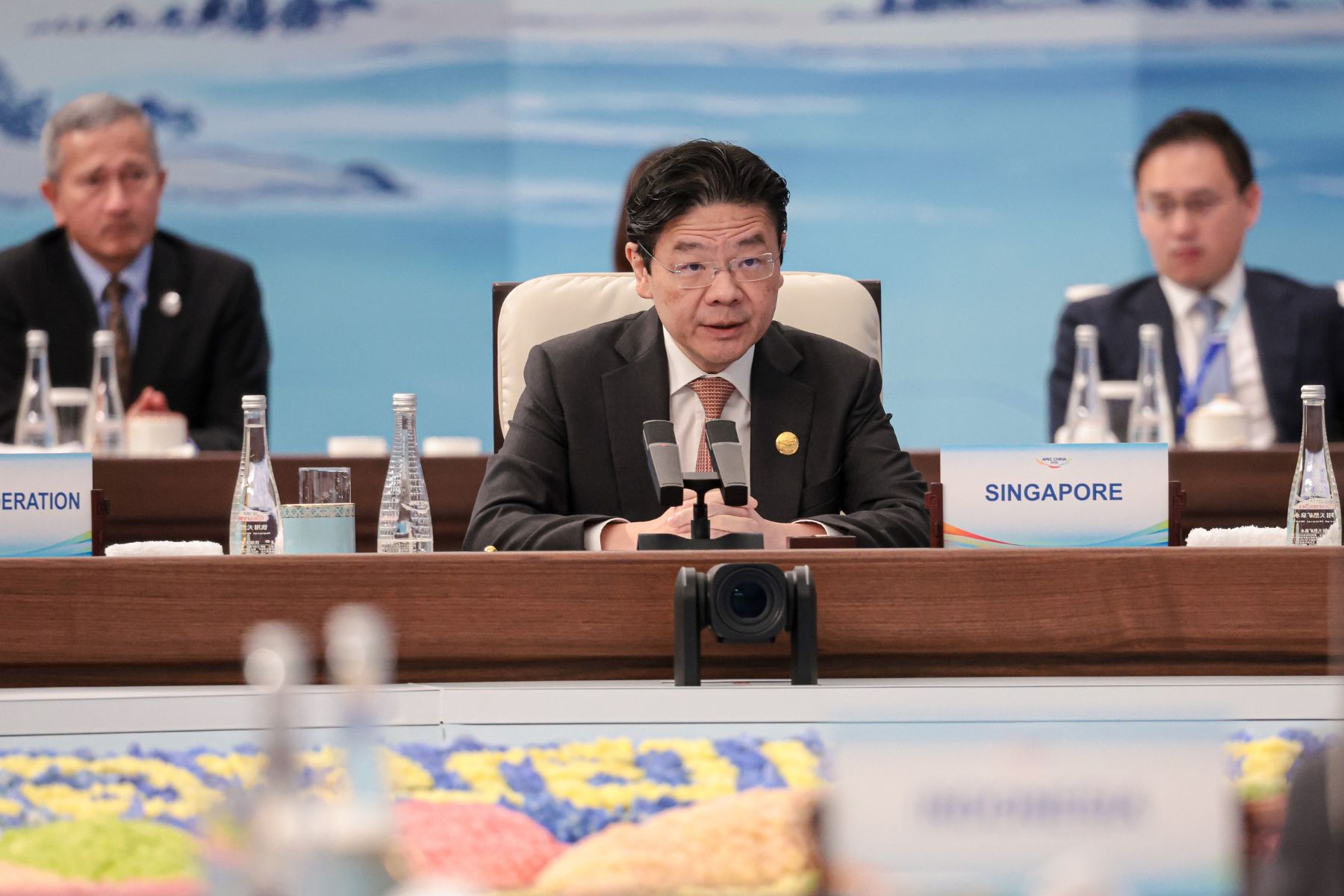
PM Lawrence Wong at the 33rd APEC Economic Leaders’ Meeting in Shenzhen, the People’s Republic of China
19 November 2026
People
PM Lawrence Wong
Topics
Economy
Foreign affairs
Governance
Remarks by Prime Minister and Minister for Finance Lawrence Wong at the 33rd APEC Economic Leaders' Meeting (AELM) in Shenzhen, the People's Republic of China (PRC) on 19 November 2026.
President Xi, Excellencies,
Let me begin by thanking President Xi for his warm hospitality and for welcoming us in Shenzhen.
Shenzhen’s remarkable transformation shows what openness, innovation and economic cooperation can achieve. It is a reflection of the wider Asia-Pacific success story, a miracle – a region that has prospered by opening up and connecting with the world.
But the conditions that made this success possible can no longer be taken for granted. Geopolitical tensions are rising, economic ties are increasingly viewed through the lens of national security. New technologies like artificial intelligence offer enormous opportunities, but also raise concerns about jobs, safety and trust.
So we are entering a different era of globalisation – one that is more contested and fragmented. We must adapt to these new realities. In particular, we should not allow our region to become divided into competing economic blocs, and that is where APEC has an important role to play.
First, we must keep the Asia-Pacific open and connected.
Our region has succeeded by building bridges, not barriers. We must preserve this openness, even as economies adjust to new economic and security realities.
Today, we have trade agreements like the CPTPP (Comprehensive and Progressive Agreement for Trans-Pacific Partnership) and the RCEP (Regional Comprehensive Economic Partnership). We should not stop there. We should build on these agreements and take concrete steps towards APEC’s vision of a Free Trade Area of the Asia-Pacific.
Our approach should be open and inclusive, to reinforce rather than to divide the wider trading system. And we must continue supporting reforms to strengthen the WTO and to uphold a rules-based multilateral trading system.
Second, we can find new ways to cooperate, even when we cannot agree on everything.
In today's world, reaching consensus amongst all economies will be very difficult. But that should not become an excuse for inaction.
At the WTO, plurilateral initiatives like the Multi-Party Interim Appeal Arbitration Arrangement and the E-Commerce Agreement show how willing parties can make progress.
New initiatives like the Green Economy Partnership and the Future of Investment and Trade Partnership can also develop innovative approaches to emerging opportunities.
We should pursue a more flexible and pragmatic approach towards multilateralism – to allow willing partners to move ahead, demonstrate what works, and keep the door open for others to join when they are ready.
Third, we should ensure that economic cooperation delivers real benefits for our businesses and people.
Ultimately, APEC's success will be judged not by the declarations we issue, but by whether businesses find it easier to trade, workers have better opportunities, and our people see improvements in their lives.
Here, APEC’s close engagement with the private sector through the APEC Business Advisory Council (ABAC) gives us an important advantage in delivering practical results.
One example is the APEC Centre of Excellence for Paperless Trade, conceived by Australia and Singapore, together with the ABAC. It aims to make it easier for businesses to exchange trade documents electronically across borders.
This may seem like a small, technical improvement. But for businesses, it means less paperwork, lower costs and easier access to new markets. And we encourage more economies to join us in this effort.
We can apply the same practical approach to artificial intelligence (AI). So much of the public discussions around AI has been about the competition for leadership position, competition for the best chips and the best models, and some of that is inevitable. But in fact, there is much scope for us to work closely together on important issues like AI safety and the responsible use of AI. And we can also cooperate on the practical application of AI to raise productivity across our economies. Here, APEC can help by supporting AI adoption amongst Small and Medium Enterprises, fostering investment in AI infrastructure, and equipping workers with the skills to benefit from these technologies.
To conclude, Singapore welcomes China’s emphasis on openness, connectivity, innovation, and shared development as shared by President Xi just now. These have been the foundations of our region’s development and must remain our guiding principles to shape the future of the Asia-Pacific.
By working together, we can ensure that our region continues to be an engine of growth and prosperity for the world.
Thank you.