
Press Conference
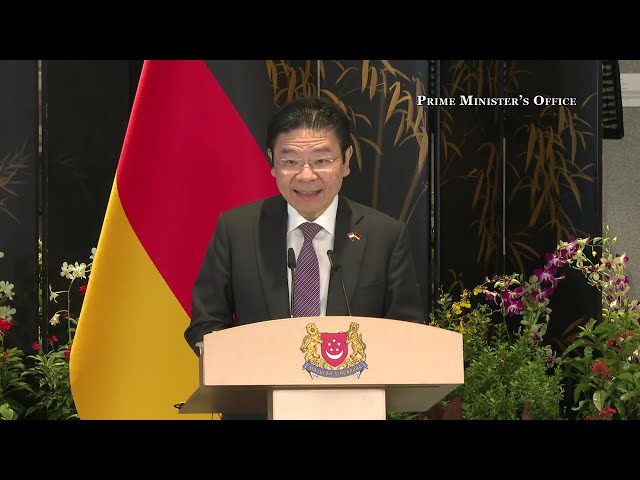
PM Lawrence Wong at the Q&A Segment of the Joint Press Conference with Federal Chancellor of the Federal Republic of Germany Friedrich Merz (Oct 2026)
27 October 2026
People
PM Lawrence Wong
Topics
Foreign affairs
Transcript of Prime Minister and Minister for Finance Lawrence Wong's Q&A segment at the Joint Press Conference with Federal Chancellor of the Federal Republic of Germany Friedrich Merz on 27 October 2026.
CNA: Singapore and Germany are set to deepen cooperation in areas such as artificial intelligence (AI) and digitalisation. What concrete opportunities do you see for Singapore businesses and workers arising from this partnership?
PM Wong: Germany and Singapore bring complementary strengths to the table. Germany is a world leader in industrial capabilities and engineering. Singapore has started to also invest in digital technologies and AI, and I think if we combine the strengths of our two countries, we can make progress in an area like industrial AI, where we can have more robotics and automated solutions in manufacturing and logistics, or many other areas of the economy.
So, we are keen to develop these sorts of partnerships, and as we go about doing so, I am sure it will open up new opportunities for Singapore companies. As the many decades of partnership with German companies have already benefited many Singaporean SMEs (Small and medium enterprises) and workers.
Likewise, in this new phase, I am sure many Singapore companies will find it beneficial to partner with German companies and Mittelstand (middle-sized companies). And as we go about doing so, there will be new jobs created for Singaporeans, and we too will benefit in terms of the skills and training that Singaporeans get in accessing these jobs.
Reuters: China and the US are leading in artificial intelligence and some other high-tech sectors. Do you think that an alliance of middle powers is actually able to compete with the superpowers? And one concrete question on trade. Are you both in favour of the EU (European Union) and Germany joining the CPTPP (Comprehensive and Progressive Agreement for Trans-Pacific Partnership)?
PM: Where AI is concerned, a lot of frontier developments are taking place in America and to some extent, China. But where Singapore is focusing on is not so much the frontier developments or the model building, but the application of AI. And there I think we have some advantages to offer. We are small. We are compact. We are highly connected as a society. We have rule of law. We have clear protection for intellectual property. We see a lot of opportunities in sectors like healthcare, logistics, finance and advanced manufacturing where we can truly push the frontiers in terms of the deployment of actual AI solutions. That is a space where we are investing in. We are making some progress, and we are very keen to work further with Germany in these areas.
As far as trade is concerned, we fully support Germany's participation through the CPTPP and the efforts that we are, we have been discussing with Germany as a leader of the EU to bring EU and ASEAN (The Association of Southeast Asian Nations) closer together, as well as the EU and the CPTPP closer together. I think in a time where the world is becoming more fragmented and divided, we want to bring more connection between different regions and both Germany and Singapore, given our shared perspectives, can make that happen.
Straits Times: You spoke about deepening ties between ASEAN and the EU. So how can Singapore and Germany work together on this during Singapore's ASEAN Chairmanship next year and also, where do bilateral discussions stand on the EU-ASEAN trade pact, and did you identify any concrete steps that can be taken?
PM: We look forward to bringing EU and ASEAN closely together, more closely together. And Singapore, as Chair of ASEAN, will certainly do our part to work with Germany, a leader in the EU, to facilitate this process next year. We are looking forward, for example, to a meaningful way to mark the 50th anniversary of EU-ASEAN partnership next year.
We are taking steps towards an ASEAN-EU FTA (Free Trade Agreement). We recognize that it will be challenging, it is complex, but we can have some confidence in moving forward because EU has also started to have bilateral FTAs with individual ASEAN countries, not just Singapore and Vietnam, but EU is also negotiating with Malaysia, Thailand, Indonesia, for example. So, more and more ASEAN countries individually are already discussing trade agreements with the EU.
And so with that, that gives us more confidence that ASEAN as a bloc, can also make progress in our trade discussions for a free trade agreement with the EU. We are also looking beyond trade to seeing how we can bring our two digital systems together. EU and Singapore have a digital trade agreement. ASEAN has now set up a Digital Economy Framework Agreement.
So with the possibility of connecting EU and ASEAN, not just in trade and investments but in also our digital systems, I think that will allow businesses to operate even more seamlessly across both regions and that will bring many more benefits to our peoples.
Deutsche Well (DW): Prime Minister, the Chancellor would like you to invest more in Germany, and you have hinted at the fact that you are thinking about this. And in light of political unrest in France and extremist political parties winning elections in Germany, do you not sometimes feel concerned, though, that your investment in Europe, in Germany, is safe? And to the Chancellor, I would like to ask, what is your argument if these concerns come up - that investment in Germany, in Europe is still worth it?
PM: I was just remarking to the Chancellor that Germany had a very successful Invest in Germany Summit recently. And many Singaporean investors had participated. Many of our investors - Singapore investors, including our sovereign wealth funds - have long invested in Germany.
It is not just, they have not only become recent German converts, they have invested for a long time, and they continue to invest going forward because they remain confident in Germany and Europe's longer-term potential. Our investors are long-term investors. They are not just investing for one election cycle. They are investing for the long term, and Singapore believes in the longer-term potential of Germany and Europe, and we remain confident in that. And we continue to invest.