
Speech
PM Lawrence Wong at the Virtual Leaders’ Meeting on Frontier AI Safety Co-Hosted by Norway and Finland (Oct 2026)
28 October 2026
People
PM Lawrence Wong
Topics
Foreign affairs
Safety and security
Science and technology
Remarks by Prime Minister and Minister for Finance Lawrence Wong at the Virtual Leaders’ Meeting on Frontier AI Safety Co-Hosted by Norway and Finland on 28 October 2026.
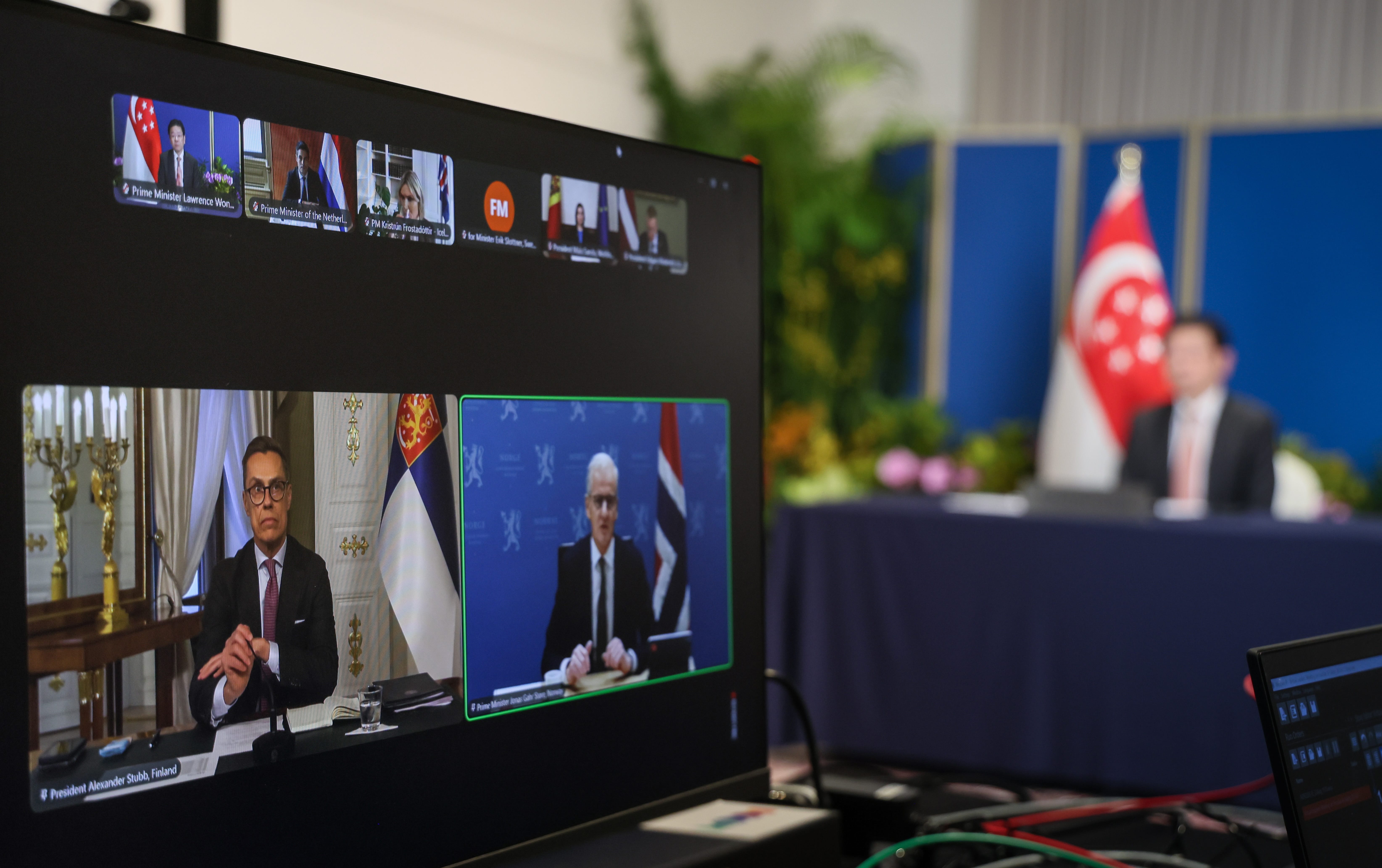
Thank you, President Stubb and Prime Minister Støre, for bringing us together to discuss this important issue. Singapore is very happy to be part of this initiative and conversation.
We know countries may have different approaches to AI governance. But we have a common interest in making AI safer, while continuing to harness its benefits.
So the question is how we turn this shared interest into meaningful cooperation. Let me offer some – hopefully – practical and useful suggestions.
First, I suggest we start with a practical and flexible approach, rather than seek to establish an elaborate new international architecture from the outset.
And one way is to organise our cooperation around specific workstreams, with smaller cross-regional groups of interested countries that can take the lead in developing practical tools and frameworks.
The participation and adoption can remain voluntary, so countries can contribute according to our interests and capabilities.
At the same time, we should build on existing efforts, rather than duplicate what is already being done.
For example, Singapore convenes an International Scientific Exchange on AI Safety. That brings together researchers, developers and governments from East and West. This has produced the Singapore Consensus on Global AI Safety Research Priorities, which can provide a useful foundation for our work.
We can also draw on the work of the Independent Scientific Panel on AI which supports the UN Global Dialogue on AI Governance.
So by connecting these different efforts, we can strengthen their collective impact and give our cooperation a wider reach.
One specific area for practical cooperation is AI incident reporting.
Because when serious AI incidents happen, the lessons should not be confined to one country or one company. We should be able to learn from what went wrong, identify the emerging risks, and take steps to prevent similar incidents happening elsewhere.
And we see the value of this in international aviation, where incidents and near misses are reported and studied, and lessons are shared, so that safety standards are continually improved. We can develop a similar culture of learning and prevention for AI.
Today, much of what we know about the safety of frontier models comes from the developers themselves. But in fact, all of us – governments, businesses and other organisations – are using these models. And as users, we ourselves encounter serious failures or near misses that reveal significant risks, even if no actual harm has occurred. And these cases may not trigger existing reporting requirements, but they can still offer valuable lessons for everyone.
So my specific suggestion is that it would be good if we can come together to share these lessons more systematically, while respecting any legitimate security and commercial sensitivities.
And as a first step, I suggest that interested parties and countries can come together to launch a pilot around AI incident reporting. We can start by agreeing on a common set of incident categories and information to be shared. We can explore how participating countries can collect and exchange this information securely. And this will allow us to test what works, identify the practical difficulties, and build confidence before considering a wider framework.
So these are my suggestions on how we can advance this initiative on the responsible and safe use of AI. I hope these suggestions are useful, and Singapore stands ready to do our part. Thank you.