
Speech
SM Lee Hsien Loong at the 80th Anniversary Dinner Celebration of the Singapore Port Workers Union
17 October 2026
People
SM Lee Hsien Loong
Topics
Economy
Jobs and productivity
Science and technology
Trade
Speech by Senior Minister Lee Hsien Loong at the 80th Anniversary Dinner Celebration of the Singapore Port Workers Union on 17 October 2026.
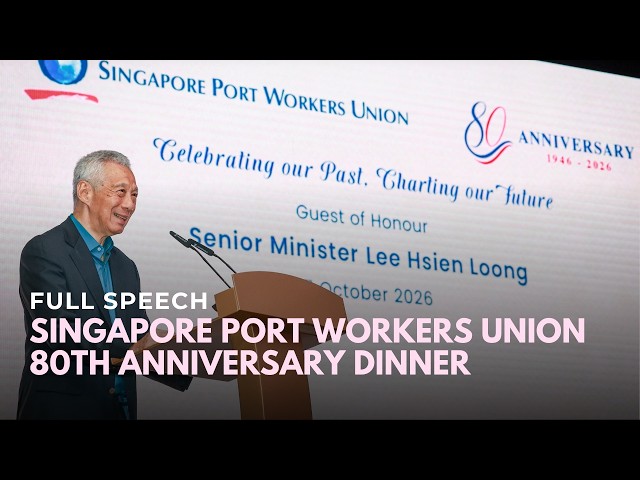
President of the Singapore Port Workers Union (SPWU), Arasu Duraisamy, SPWU Executive Council Members, brothers and sisters from NTUC, Members of PSA’s Board and management, friends, a very good evening to everybody.
Congratulations to SPWU on reaching your 80th anniversary!
I am pleased to celebrate the occasion with you, and especially touched and moved by the honour that you have conferred on me. I have had many dealings with SPWU, stretching over many years. I have greatly respected your determination to fight for the welfare of port workers. And your commitment to work with PSA’s management and the government to make ours one of the best container ports in the world. I am proud to have become an honorary member of the SPWU.
The origins
The sea has always been Singapore’s open passage to the world; our port – the gateway.
Our maritime story is well-known. For centuries, Singapore functioned as a regional trading post on an ancient maritime silk route between China, India and Europe. Two hundred years ago, the British arrived and built a free port in Singapore, and we became a major entrepot. After independence, the entrepot trade model was reaching its limits, but we did not give up on our port. We pivoted to container cargo, invested in modern port infrastructure, and made ourselves a major node in the global maritime trade.
But a port is not just ships and cargo. At the heart of the port is people. A hardworking and adaptable workforce has long been the backbone of Singapore’s maritime industry. This is what ultimately makes our port tick.
Decade after decade, as Singapore advanced from third world to first, we steadily upgraded our port operations. Dock labour experienced great transformations. Generations of port workers participated in the rapid changes.
In the early colonial days, dock labour was fragmented across different contractor networks and stevedore coolie lines. Working conditions were harsh. Hard physical labour was the norm. Workers received unpredictable daily-rated wages.
After the Second World War, the British began to register and regulate organised labour, and harbour workers seized the opportunity to establish legal collective bargaining rights. In 1946, the Singapore Harbour Board Staff Association (SHBSA) became the first union to be officially registered under the Trade Unions Ordinance. Since then, the union has played an important role helping port workers secure better wages and working conditions.
During the turbulent 1950s, the port became a battleground for worker rights and anti-colonial agitation. There were strikes and go-slows, as the militant union tussled with the Singapore Harbour Board (SHB). Mr Lee Kuan Yew was the SHBSA’s legal advisor. He recommended that the various port labour unions merge to strengthen their bargaining power. And eventually they did, and SHBSA became the sole union representing all daily- and monthly-rated workers.
In 1968, the Singapore Harbour Board was reconstituted into the Port of Singapore Authority (PSA). And the SHBSA changed its name to the Singapore Port Workers Union (SPWU).
Post-independence
After independence, with the advent of tripartism, SPWU abandoned the adversarial approach of strikes and confrontation, and embraced the cooperative relationship that defines labour management relations in Singapore today. On their part, PSA’s management reciprocated this change in approach. That turned a new page in our port development story.
In the years since, our port has flourished. In 1972, PSA opened the first container berth in the region at Tanjong Pagar. Because we bet on containerisation and invested in it earlier than other ports, we gained a first mover advantage and made ourselves the container hub in our region. Cargo volumes grew exponentially. By the 1980s, PSA had become one of the busiest container ports in the world, ranking second and sometimes first by container volume in the decades since. In 2000, we opened the Pasir Panjang container terminal, tripling our handling capacity.
Today our port is thriving. Last year, PSA handled almost 45 million TEUs, a record. This is all the more impressive considering that PSA’s traffic is almost all based on transhipment, unlike other top ports like Shanghai and Ningbo-Zhoushan, which serve a huge hinterland, and derive their volumes primarily from exports and imports.
But we have ambitious plans to keep on growing PSA. We are expanding our port infrastructure even further. We are consolidating port operations at Tuas, from the Tanjong Pagar, Brani, Keppel, and Pasir Panjang Terminals. When fully completed in the 2040s, Tuas Port will have a capacity of 65 million TEUs – a scale we could not have imagined back in 1965.
Beyond this, the port will surely have potential to grow further. We must make the most of technology to increase throughput at Tuas beyond 65 million TEUs. And we must also study carefully how we can further enhance our port capacity, given our land constraints. A thriving hub port will always be a crucial part of the Singapore economy.
Tripartism: the key success factor
To outsiders, the past six decades look like an unbroken string of successes.
But those of us who have participated in this journey know just how much hard work actually went into it – how many difficult strategic choices we faced along the way; how many times we needed to transform the way we operate; and how from time-to-time we made missteps, and painfully corrected them.
Thanks to the combined efforts of PSA’s management team, the unions, and the workers, we succeeded, and brought PSA to where it is today. Close teamwork enabled us to achieve together what none of us could have done alone.
A relationship of trust between PSA management and the unions enabled us to work well together as a team, to help workers adapt to changes as the port grew and as technology advanced – first from manual stevedoring and bulk-breaking to container traffic; then from quayside and yard cranes with individual operators on top of each crane, to operators controlling multiple cranes simultaneously and remotely, sitting in a control centre in a more comfortable setting. In the container yard, instead of people manually driving prime movers hauling containers under sun and rain, we have remotely-operated Automated Guided Vehicles (AGVs) performing the task.
Each time the jobs changed, PSA sought to retrain existing workers to take up these new roles, rather than to hire afresh. The company developed structured training programmes, sometimes in partnership with external institutions like ITE, to help workers acquire the new skills needed. On their part, the unions persuaded and cajoled workers to adopt a flexible mindset, take up the training opportunities to upgrade themselves, and assume these new roles.
Each episode was a challenging and laborious process of organisational change and personal adjustment. Each required close coordination between port management and the unions – to help workers accept radical changes in their work processes, to upgrade themselves as their roles changed, and then safely and successfully adopt new ways of working, sometimes in new places.
The port itself has moved several times. Each expansion to a new location – to Keppel, Brani, Pasir Panjang, Tuas Port – required workers to adjust to a different work environment and commuting arrangements. Tuas, in particular, made commuting significantly longer. PSA has made extensive transport arrangements to make it more convenient for workers. On their part, the unions have helped workers adjust to these new work locations. And SPWU are now participating in a Tripartite Committee with PSA management and Government agencies to improve the commuting experience. As a result, we have increased bus services to Tuas South and we are studying the possibility of building a Bus Rapid Transit system.
At times, we had to take painful decisions. For example, in the early 2000s, PSA lost several major shipping customers to the Port of Tanjung Pelepas (PTP). PSA had to change strategy. It needed to cut costs decisively, to restore its competitiveness and win the business back. That meant retrenchments and job losses; and for those remaining, wage cuts.
PSA management took pains to explain to the unions why these drastic steps were necessary, and to enlist your help to turn the company around. On your part, SPWU negotiated hard with management to secure the best possible deal for the workers who had to leave, while keeping sight of the bigger picture. Together, you put together a retrenchment and wage-reduction package that would save the company, and was at the same time fair to the affected workers. Throughout the process you handheld those affected, and ensured that no one had to face these difficult times alone. Nevertheless, it was a wrenching and painful experience, not only for the affected workers, but for all those who had to deal with the issue, both on the union and management sides.
But when PSA did well, management was also fair to its workers and unions, ensuring that all shared in the upside of the company’s success. After the drastic corporate reset in 2003, PSA turned the corner and made a strong recovery. In 2005, PSA paid a special gain-sharing payout to workers. It was a reward for meeting cost-reduction and performance targets during a trying time; and also a gesture of appreciation for the workers’ contributions and sacrifices.
Such intimate cooperation between management and the unions, through both ups and downs, was instrumental in building trust between them, and a key reason for PSA’s sustained success.
On the union’s part, generations of elected officials and Executive Secretaries have fostered this relationship of trust and cooperation – ensuring that workers’ voices are heard, negotiating hard on behalf of workers and helping those in need, while appreciating PSA’s importance to the Singapore economy, and importantly, understanding what the workforce must do to stay competitive, and persuading workers to embrace and pursue these efforts.
SPWU’s approach contrasts sharply with the approach of some other port worker unions elsewhere, which resist technology and progress tooth and nail. They believe this is the way to protect their members’ jobs and interests. But over time their ports suffered, and so did their members. SPWU’s forward-looking, enlightened approach has served its members well, and PSA too. For that, I am deeply grateful to SPWU, and I know so is PSA’s management. Thank you very much. Long may this relationship of mutual trust and cooperation continue.
SPWU is now going through a major leadership transition. Many stalwarts are stepping down after years of dedicated service. A new generation of union leaders is taking over. The new leaders, like your predecessors, must understand the union’s long history, and the depth and nuances of your responsibility to members and your relationship with management. You must absorb the right lessons, but also appreciate that old strategies may not be enough. You must be open and forward-thinking, and find new ways to help workers meet new work demands and challenges, and in the process earn their trust and support. You must work hard to forge a new compact with workers and management alike, and renew the tripartite partnership for the future.
Building on success
Looking ahead, we must expect continuing challenges. PSA has done well, adopting technology and upgrading your operations to keep our port efficient and competitive. But other ports in the region are making progress digitalising and automating too. They are fast-catching up, and in some respects quite possibly ahead of us. Some of you visited Shanghai’s Yangshan Port a few years ago on a learning journey, and saw for yourselves how advanced they were. They too, already had remotely-controlled quayside cranes. And this was some years ago, and they have not stood still since. If PSA slackens or becomes complacent, we risk being left behind and losing our business.
Apart from competition from other ports, the industry itself is transforming in fundamental ways. Supply chain disruptions, climate change, geopolitical tensions are all affecting shippers and port operators. Green fuels such as ammonia and methanol will require new processes, skills and safety protocols. Rapid advances in AI, autonomous technology, sensors and robotics are already dramatically transforming port operations. Even repetitive physical tasks such as coning and de-coning may one day be automated by embodied AI.
These developments present new challenges, but also new opportunities. There will be higher-value tasks which are less physically demanding; better jobs, centred on data, judgement and decision-making; and even completely new roles that do not yet exist − in areas like sustainability management and alternative fuel options. These skilled roles will enable workers to deepen their expertise, enlarge their responsibilities, and build fulfilling careers. PSA must keep abreast of these changes and reinvent itself, again and again, in order to turn these new challenges into opportunities.
As in past waves of transformation, we must not leave workers to face these challenges alone. More than ever, we will need a strong and well-led SPWU, working closely with a competent and innovative PSA management team, to secure PSA’s success, and workers’ livelihoods. This is the way to build a disciplined and skilled workforce with a strong Singapore core, and secure for them a fair share of the fruits of their labours. The Government will work with management and unions to equip every worker with the skills needed to seize these opportunities with confidence.
Conclusion
With the strong tripartite partnership between Government, industry and unions, I am confident that we can continue to ride the waves of change, and create a brighter future for generations of port workers to come.
Happy 80th birthday SPWU! Thank you very much.