
Speech
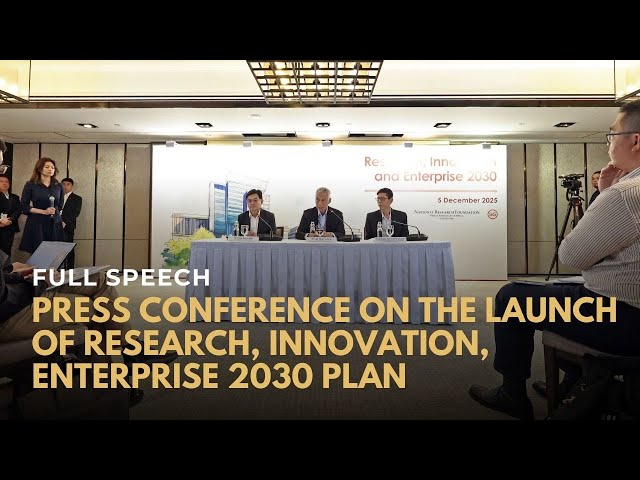
SM Lee Hsien Loong at the Press Conference on the Launch of Research, Innovation, Enterprise 2030 Plan
People
SM Lee Hsien Loong
Topics
Science and technology
5 December 2025
Speech by Senior Minister Lee Hsien Loong at the press conference on the launch of Research, Innovation, Enterprise 2030 Plan on 5 December 2025.
Good afternoon, everybody.
Today we held the RIEC meeting and we are launching Singapore’s Research, Innovation, Enterprise 2030 Plan, or RIE2030 Plan.
RIE Achievements To-Date; RIE2025 Highlights
RIE2030 is our next five-year plan to strengthen our national research and innovation ecosystem. It builds on the $28 billion RIE2025 plan that covered the last five years – 2021 to 2025 – and that in turn built on previous RIE and Science & Technology (S&T) five-year plans.
These sustained investments by the Government into Science & Technology, and RIE have built a strong talent base and robust research capabilities in Singapore.
RIE2025, the most recent plan, has contributed to our economic growth and vibrancy. Collaborations between public institutions and industry have attracted and anchored corporate R&D labs here. For example, we have secured more than $18 billion worth of semiconductor investments just in the past two years, and industry leaders like Applied Materials, Micron, NXP Semiconductors, Vanguard International Semiconductor, Pall Corporation and Siltronics have either announced or opened new facilities here. In the field of advanced manufacturing, the partnership between A*STAR, Rolls Royce and Singapore Aerospace Engine Services has produced 18 technology breakthroughs that improve fan blade manufacturing and repair, and they have increased factory productivity by 20%. Our tech start-up ecosystem is also thriving. For the past five years, Singapore’s deep tech startups have attracted $1 billion or more of venture capital funding every year, reflecting the quality of these start-ups. Several have done very well, for example, MiRXES is a medtech start-up from ASTAR which worked closely with the Singapore Gastric Cancer Consortium, NUH, and NUS to develop the world's first microRNA-based test to detect early gastric cancer. This year, MiRXES became Singapore’s first BioMedTech unicorn. Advanced Micro Foundry (or AMF) is another one of our companies, a spin-off from ASTAR’s Institute of Microelectronics. Last month, Global Foundries, which is a leading manufacturer of essential semiconductors, acquired Advanced Micro Foundry. This will expand Global Foundries’ silicon photonics technology portfolio, production capacity and R&D in Singapore.
RIE has also contributed significantly to Singapore’s national priorities. During COVID-19, our researchers were among the first in the world to culture the SARS-CoVid-2 virus. They rapidly developed diagnostic kits, and conducted research which informed our public health and vaccination policies. Our long-standing research programme on myopia has developed a treatment for myopia, a low dose atropine treatment, which significantly slows the progression of myopia (short-sightedness) in young children.
These long-term investments in basic research enable us to seize opportunities in emerging fields like quantum computing. For example, we set up the Centre for Quantum Technologies back in 2007. Next year, Singapore will become the first country outside the US to host Quantinuum's Helios System quantum computer. This will accelerate innovation in pharmaceuticals and materials science, while developing local expertise.
RIE2030 Highlights
Research and innovation will become increasingly important as our economy matures. It will drive economic growth, and help us to address national priorities and challenges.
The Government believes in sustaining stable and consistent investments in RIE, through thick and thin, over the long-term. Through RIE2030, we will be investing $37 billion over the next five years in R&D, which is about one per-cent of our GDP, and that is a level we have been maintaining now for nearly 20 years.
The RIE2030 plan will use R&D to support key economic and national priorities, to build capabilities in AI, data and compute, to enable cutting-edge research and innovation, and to strengthen our talent pool and basic research capabilities. So that is in terms of the overall shape of RIE.
Structurally, we will continue to invest in each vertical Domain, or its specific sectors − Manufacturing, Trade & Connectivity; Human Health & Potential; Urban Solutions & Sustainability; and Smart Nation & Digital Economy. And we will also support the horizontal enablers − Academic Research; as well as Talent. In the previous RIE, Innovation & Enterprise was a third horizontal enabler. But this time, we have decided to restructure it, and to take Innovation and Enterprise under each vertical domain, because this will help us better develop end-to-end sector-specific innovation and enterprise strategies for each domain. At the same time, we will continue to support, across the board, early-stage research translation and enterprise innovation activities in all fields and sectors.
RIE Flagships and Grand Challenges
The one important change in RIE2030 is we will now have a few RIE Flagships and Grand Challenges. These will be large national programmes with a strong mission focus. Each national programme will develop a coordinated portfolio of research projects to address major challenges in one single important sector or area. This will help to focus our efforts and our attention, and create more value and impact.
So we will start off with two RIE Flagships and two RIE Grand Challenges. Today we are announcing one each. And the first RIE Flagship will be in semiconductors. The semiconductor industry is a key part of our economy. Within the next five years, by 2030, the global industry is expected to reach $1 trillion in revenue, with an additional $300 billion of potential upside because of Generative AI. The Semiconductor Flagship’s goal is to make Singapore a strategically important R&D node in the industry. It will anchor and expand high-value corporate research and manufacturing in Singapore, to support the growth of globally competitive local companies and deep tech startups.
Our first RIE Grand Challenge will be “Maximising Healthy and Successful Longevity”. Aging, as we all know, is one of our most pressing national issues. By 2030, a quarter of Singapore’s population will be aged 65 or older. The Grand Challenge will tackle critical knowledge gaps, and strive to delay the onset and progression of cognitive decline, and the loss of physical function in older people. It will also aim to improve our understanding of the biology of aging, and develop new approaches to sustaining brain health and physical function, through healthcare, socio-environmental, AI and technological innovations.
And the other initiatives are being discussed and we will announce them later on.
Conclusion
Singapore will sustain consistent long-term investments in RIE. Ours is a society with an ethos of embracing science and scientific evidence. And we are resource-disadvantaged, so all the more we need advanced science and tech capabilities more than other societies.
Research and innovation demands imagination, curiosity, creativity, risk-taking and collaboration across disciplines and sectors. And a critical success factor is high-quality talent. Therefore, we will continue to nurture our own talent and provide ample opportunities for their development and growth. At the same time, as we attract and anchor overseas talent here, to enrich our research and innovation ecosystem.
RIE2030 will enable Singapore to remain a place where diverse minds can collaborate effectively − to push the boundaries of knowledge and its application, and at the same time, to propel Singapore’s development and improve lives for all of us.