
Dialogue
SM Lee Hsien Loong at the Regional Outlook Forum 2026 Opening Remarks
People
SM Lee Hsien Loong
Topics
Economy
Foreign affairs
Safety and security
Trade
8 January 2026
Transcript of Senior Minister Lee Hsien Loong's opening remarks at the Regional Outlook Forum 2026 on 8 January 2026. The session was moderated by Professor Chan Heng Chee, Chairman of the Board of Trustees of ISEAS – Yusof Ishak Institute.
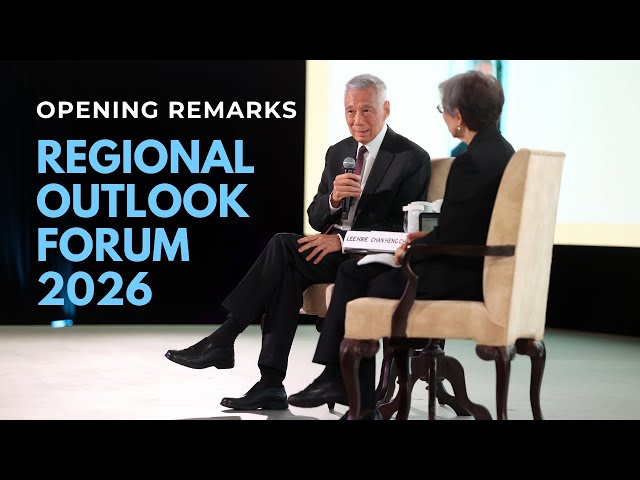
Good morning everybody, and Happy New Year. Last year has been a year of strategic changes in the world. They are major. They have lasting effects. The immediate consequences – life goes on and we feel that perhaps, it has not been as fearsome as expected. But I think we should make no mistake that these are significant long-term changes which will have a major impact on our lives.
Trade
First, on trade. 2 April – I think everybody knows what happened. The Trump administration tariffs upended the global trading system. People feared the worst. The results have been slightly less bad than that, we are relieved. But in fact, it is a very drastic change. The results have been slightly less bad because the tariffs have been lower than initially headlined; because the implementation has been slower; because the US has had an AI tech boom which has driven the US economy, and that has carried us along.
But we should understand that it is a drastic change. Because in a multilateral trading system anchored by the US, based on Most Favoured Nation (MFN) status, now the anchor player, the US, has said, “I am not playing. I am opting out, and furthermore, I do not want to do business like that. I am going to deal bilaterally, one on one, and on the basis that I will tariff you. And I will use my tariffs as a policy tool for many other purposes as well”.
And meanwhile, in that circumstance, the world has to go on. The consequences will take some time to play out because other countries will react. They will act to defend themselves, to retaliate perhaps, to secure their own supply chains. And the consequences will take time to play out. But that is going to hurt the world economy and lead to less stability, less growth, less prosperity, less economic integration and technological progress. I think that is not in doubt.
Security
On the security side, there have been major changes too. In Europe, the European countries are engaged in deep soul-searching now, on what responsibility they can take for defence and how they can come together, in order to determine their own security policy and be less dependent on the United States. It is going to be not just a lot of budget. There is also going to be the difficulty of coming up with a European policy, security direction, and action.
And that is a fundamental change to the world. And Ukraine, which is on the frontline and at war, in this world with a completely different US, will now have to think, “What is a realistic path forward for our country?”.
In the Asia Pacific, we have not had a NATO- style Munich Moment. But the key factor in the Asia Pacific is the US-China relations. Fundamental tensions remain, but on top of that is overlaid a reluctance on both parties to incur the cost of a full-scale trade war. And so, some accommodation has been made. And we hope that will also help to manage the underlying tensions, although that will not make them go away.
For the rest of the countries in the Asia Pacific, the US is still a very important partner − security partner, economic partner, investment source, and destination for further studies. There are many interactions. But at the same time, these countries also know that China is a major and growing economic, and more-than-economic partner, and reality. And so, what do they do? I think all the Asia Pacific countries must also be rethinking their positions carefully too.
I think a lot in the Asia Pacific will depend on how China decides that it wants to engage its regional neighbours and the world. And China has been making the right statements about multilateralism, about MFN trade, about rules-based systems. And we hope to see that this will be realised as real policies, as issues are implemented. It will be a difficult ride.
Rules-based international order
For the rest of the world, I think one major change has been that the US has been more willing to act unilaterally, when it sees its national interest require this. It has done this in the Middle East. It has intervened militarily in Nigeria, which it has never done before. Most recently in Venezuela, and now seriously under consideration, some action in Greenland.
In the short term, these actions have sometimes had spectacular and even positive results. In the Middle East for example, there is a ceasefire in Gaza, imperfect though it may be. And there was a spectacular strike on the Iranian nuclear facilities.
But the longer-term consequences of these actions, even at the target, and the broader consequences of these actions for the rest of the world and for the global system – a system which is based on UN (United Nations) principles, which is based on the UN Charter, which is based on international law, which is based on countries understanding that you have to coexist with one another peacefully and work with one another, because going to war has grievous and very unpredictable consequences – I am not sure that that has been furthered by this environment.
How should ASEAN respond?
What does ASEAN do in this situation? I think the first thing to do is to work together as one, cooperate more closely with one another and deal with our external problems as one unit, rather than as 11 different countries.
We are diligently working on this in terms of economic cooperation, in terms of infrastructure, in terms of working on the digital economy, for example. And there are many more things we can do. And Ibu Mari Pangestu, who will be on stage later, has authored a study on ASEAN agency in this world.
But at the same time, ASEAN countries have some very difficult problems to resolve. Some of them – Myanmar internally, Thailand and Cambodia with an armed conflict – not really fully resolved. And ASEAN has to try and resolve them with some difficulty.
Will 2026 be better than 2025?
So, this is a complicated world. If you ask me, what happens in 2026? I would say, as far as the growth is concerned, it could be plus a bit, minus a bit compared to last year. Last year was better than expected. This year may be better or worse. It is neither here nor there. These things vary from year to year.
What has happened is that we have undergone a sea change. We are now in a different world, and we are going to see the consequences of the sea change in the economy, as well as in the security area in 2026, and for many years to come.
We hope we do not have any tectonic shocks again. I cannot say for sure. Nobody can predict these things, but we hope that 2025 will have been more exciting than 2026.
Thank you.